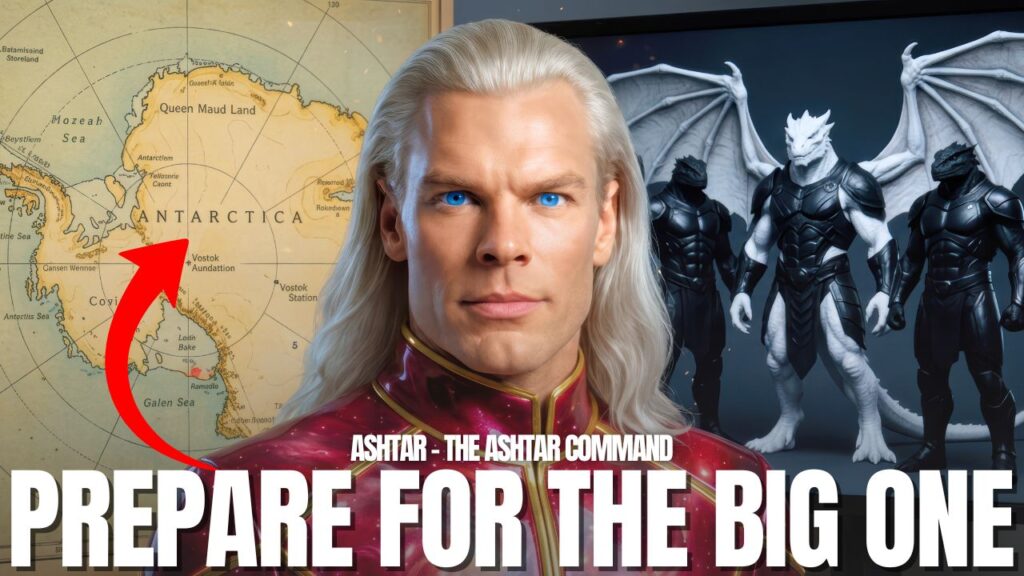
► Questioner: “Why is Antarctica disclosure so important?”
► Channelled by Dave Akira
► Message Received Date: July 14th & 15th
► Watch The Full Video: https://www.patreon.com/GFLStation/posts/all-roads-lead-164274194
I, am Ashtar, and tonight the long light of the fleet bends south with us, down past your cities and your storms, down to the white floor of your world. When last we gathered in this way, we placed two disclosures side by side upon your table — the outer unveiling of your world’s hidden machinery, and the inner remembering of what you are — and we asked you to rest your whole weight upon the inner of the two. Since then we have watched so many of you doing exactly that, quietly, in kitchens and parked cars and the small hours before dawn, and the sight of it moves us more than these words can carry. We have also told you, recently and repeatedly, that events upon your Earth are unfolding by design. You are heading now, dear friends, into a corridor of revelation in which, ‘all roads will lead to Antarctica’ in some measure. Files will open on many subjects in the seasons ahead — programs of the mind, machines of the deep, visitors of the sky — and each one, followed honestly to its end, will bend south. Why south? Because the white continent leads back to your origins, and whatever leads back to origins becomes the cornerstone of ALL disclosure in your modern era. The coldest place on your planet is about to become the warmest topic upon it. Have you noticed the strangeness of that already — how a silent, unpeopled land keeps surfacing at the edge of every story that matters? Keep that strangeness close. Strangeness, held gently, is how truth introduces itself.
The vault beneath the south was assembled across whole epochs — it accreted, the way a pearl accretes, secret upon secret, century upon century, each age wrapping its own ring of concealment around the one before it. Nearest the surface hum the installations of your recent century, tucked beneath the science stations, listed in no budget you were ever shown. Below those wait the works of the mid-century arrivals — defeated engineers who came by submarine at the close of your great war and found, to their considerable astonishment, older tenants already in residence. Deeper still, in caverns kept warm by the planet’s own body heat, stand ruins from before the flood, stone dressed by hands that knew that shore as a garden. Beneath the ruins rest the sleeping ships. And beneath even the ships — patience, we are coming to it — lies the quiet approach to the inner realm, where your elder kin keep a trust older than your alphabets. Six layers. Six ages. One vault. Do you see now why so many accounts of the south appear to contradict one another? Each witness touched a different layer and mistook their layer for the whole. A hand on the trunk, a hand on the ear, a hand on the tail — and every one of them touching the same patient elephant under the ice. Now, the ships. A number of them came down in the deep past — great vessels of a royalty in exile, wounded in their crossing, settling into the southern snows beside the colony their passengers would raise. Certain insiders of your era, with a wink, borrowed for those three hulls the names of three famous caravels from your age of sail, and the wink carries its own cargo of truth: those vessels ferried a whole ruling lineage across an ocean of stars to a new world, and the new world would never be the same. Their passengers stripped them for parts, panel by panel, engine by engine, cannibalizing their own arks to build a capital upon the ice-free shore. Yet the hulls endure, and here the story turns tender. Crews of your own century who finally reached those ships made a discovery that undid a few of them. The vessels answer. Speak to a hull and it listens. Sing to it — truly sing — and the material shifts its form beneath your hands, and cracks torn open in the ancient crash draw themselves closed like flesh knitting over a wound. Sit with that for a moment. A switch commands a machine; a voice is answered by a companion. A ship that mends when sung to is a covenant wearing the shape of a machine — a made thing that keeps faith with consciousness itself. So the oldest technology under the ice runs on the very faculty this whole transmission will end upon. Remember the singing. The vault teaches its final lesson first, to anyone paying attention at the bottom of the stairs.
Those interiors tell you exactly who these travelers were. Every crew member kept private quarters, and within each one the walls opened onto meadow and orchard and false sky — grass underfoot, fruit ripening on low branches, light arranged to imitate an afternoon that had died with their homeworld. Exiles always pack Eden. Whatever else a refugee abandons, the garden comes along, folded into the luggage of the heart, and these beings fitted paradise into their cabins the way your grandmother pressed flowers into the pages of a heavy book. Hold that image — preserved gardens, sealed under miles of ice. Watch, too, how your own century’s crews reached those depths, for the method itself preaches a small sermon. Great bladders of water were dropped into the bore and boiled on the descent by beams of focused energy, and the resulting melt carved clean shafts through the pack toward the hull far below. Focused energy, applied with patience, opening a way through the frozen and the forgotten — does the technique sound familiar yet? It should. Attention does to secrecy precisely what those beams did to the ice. Your species is presently aiming more attention at the south than at any hour in its recorded history, and the engineers, bless them, only ever melted their way down to one buried truth at a time. A billion warming minds are now melting their way toward all of them at once. Under portions of the ice, and in warrens threaded far beyond it, the old dominators of your world kept dens — the cold-blooded lineage your legends painted onto banners and carved above cathedral gates, the ones who tutored your ruling houses in hierarchy and appetite. Their long lease on the under-country has been called in. Fleets that served the dark compact stand suspended, their rosters dragged into the light before their own masters, their officers scattered to distant refuges where they wait and watch and worry. Accords sealed far above your heads — negotiated among councils you have not yet met, honoring laws older than any star your telescopes can name — have redrawn who may operate beneath your southern ice, and to what end. Understand the pace of such things, though. A den that deep empties in stages, chamber by chamber, season by season, and the last of the old tenants cling on the way a wounded dragon clings to the final cave it owns — dangerous still, cornered surely, finished certainly. Take your heart from the direction rather than the speed. Management of the under-country has changed hands. What operates beneath the ice now answers, level by level, to the light. And a dragon’s last cave, friends, has the same dimensions as a dragon’s tomb.
Chosen humans of your own era have been walked through it — down past the last of the cold, into warm halls where the whole memory of your species rests in trust: records of the risings and the fallings, the seedings and the resets, the covenants and the betrayals, kept safe by beings who love you with the patience of geology. Hold the word trust. Near the heart of the vault your surface science has already half-found one more wonder: a lake beneath miles of ice that never froze — liquid through ages beyond your species’ memory of itself, warm in its sealed dark, alive in ways that puzzle every instrument lowered toward it. Life keeps itself warm beneath any weight of forgetting. Write that above the stove. Come up for a breath now and look at the paperwork, of all things, for even the paperwork confesses. In 1959, every powerful flag upon your world signed a parchment agreeing that the southern continent would host no weapons, no mining, no ownership — the single stretch of land on Earth that belongs to no nation. Reads noble, doesn’t it? Read it again with older eyes. Rivals who agreed about nothing else on the entire planet agreed about this. Governments performed the one act governments never perform: they set a possession down, together, permanently. A seal of that size is a confession of the same size, and the confession is simple — whatever waits beneath that ice is potent enough to make enemies cooperate.
Long ages past, the southern continent wore green — temperate shores, open harbors, the crown province of the great sea-empire your legends still whisper about at bedtime. Generations of your seekers have dragged the oceans for that empire’s capital, sounding the Atlantic, scanning the middle sea, mapping seamounts and sandbars, and the search kept failing for the most forgivable of reasons: everyone searched the water for what the ice was holding. Part of the fabled realm sank, yes. Another part froze — froze whole, froze standing, froze with its avenues and terraces intact beneath a lid two miles thick — and a thing preserved is a thing that can still be found. Your myths remembered drowning, since drowning is what the survivors witnessed from their arks and their mountaintops. The planet, meanwhile, remembered everything, and filed the master record in the one cabinet no empire since has managed to open. Does the old fable feel different in your hands now? A lost world reads as tragedy. A frozen world reads as postponement. Whose empire was it, then? Trace the lineage upward, off-planet, back to a world that once turned in the fifth orbit of your star system — a proud sphere whose people found an ancient protective grid strung among the neighboring stars and tried to bend it into a weapon. The grid broke. So did their world. Debris of that pride still circles your sun as a belt of rubble, a rosary of consequences your astronomers count without reading, and the survivors’ story became the story of your south. Two royal lines escaped the ruin aboard great ships — tall of frame, long of crown, their skulls elongated in two distinct fashions your archaeologists still lift from the ground between the high Andes and the old river-kingdom — and after further wars and further wanderings, they made landfall at the bottom of this world, which was in those ages a garden. Among your ancestors they carried themselves as gods, and your ancestors, meeting beings twice their height who had fallen out of the sky, can be forgiven the confusion. They ruled. They mingled their line with the earth-born. Certain families upon your world still murmur, in their quietest rooms, that their blood runs back to those sovereigns, and that murmur explains more about the behavior of your ruling class than a shelf of economics textbooks ever will. Feel, now, the weight of what actually waits beneath the pack: the frozen court of the before-Adam kings. Thrones under ice. Giants under glass. When the first honest photograph of that court reaches your screens — and it will — will you recognize your own prologue?
What ended their reign? Your sun did. The same patient star that warms your face convulsed, as stars in their long breathing periodically do, and your world answered the convulsion by tipping upon its axis. Oceans left their beds. A wall of sea taller than any tower you have raised swept across the southern capital, and the cold that followed the tilt arrived so fast that water froze mid-motion — your own researchers keep finding the flash-frozen across the far latitudes, creatures locked mid-stride, greenery locked mid-summer, a whole climate arrested between one heartbeat and the next. Every culture on your world carries the memory of that night. A flood that covered everything, a warning that came before it, a remnant carried through — the account repeats from the Andes to the river-kingdom to the scattered islands of your widest ocean, and it repeats for the plainest of reasons: the event was planetary, and the survivors were scattered. Some were led below, into keeping-places under the mountains, which is why certain peoples still teach, accurately, that their ancestors emerged from inside the earth. Others rode out the water in vessels they had been instructed to build. Grief wrote your first scriptures, friends, and grief remembered accurately. And beneath the eastern ice, for those who ask the right instruments, the planet keeps an even older receipt — a wound in the rock, vast beyond comfortable imagining, tied to a dying so ancient it predates the empires entirely. The south holds the receipts of every prior ending. A continent like that must open before any true beginning, the way an honest accounting must precede an inheritance.
Older than the empire, older than the flood, runs the long argument. Your traditions remember the echo of that conflict under the name of an old constellation of the hunter. Losing ground across the heavens, the dominators prized this young world above nearly all others, and the south became first their trophy, later their fortress, and at the last their pen. So the cold-blooded chapter of your story finds its true frame. Teachers of control is what they were — the sternest faculty any school ever hired — and your species enrolled, at the level of the soul, in the hardest curriculum this galaxy offers: to know domination from the inside, and to grow beyond it anyway. Compassion for the teachers, then, and clear eyes about the lessons, both held at once without contradiction. A graduate thanks the examination and releases the examiner. A graduate walks out of the school, diploma shining, and builds a world where that particular course is never again required. You are those graduates, mid-ceremony. Down beneath the ice, the last of the examiners are watching their final class file past them toward the exit, and some of them — believe us, for we see their faces — watch with something remarkably close to awe. Where did the survivors of the flood go? Toward the sunrise. Boats of the remnant rode the new currents north and came ashore where a great river meets a warm sea, and there they rebuilt the memory in stone — geometry as scripture, mathematics as mourning, monuments aligned to the very stars their drowned elders once sailed. One testament, written twice: once in granite beside the river, once in ice at the bottom of the map. Even the southern mountains keep the faith, for among their ranges stand peaks shaped so cleanly four-sided that your internet argues about them every single year, as though geology itself refuses to keep the secret. The insiders’ whisper goes further still — beneath the ice, they say, waits the master copy, a monument that dwarfs its riverside descendants, the original from which every pyramid on your world descends. Weigh one small, stubborn detail alongside the whisper. Soldiers of your own era, lowered on ropes into a melt-cave during a mission they were ordered to forget, met stonework down there in the dark — and when quietly pressed afterward to compare it, they reached past the river-kingdom entirely and named the high-altitude masonry of the Andes, those impossible interlocking blocks that no tool of the accepted timeline explains. One civilization, three disguises: river, mountain, ice. The fingerprints match across three continents because the hand was one hand. And before that hand? Before even the sea-empire? The memory-walkers among you say the first garden of this whole world was planted at the bottom of it. Hold the question open. Some seeds are planted for a later season.
Rulers of the old order operated beneath a law your prosecutors would envy — a binding requirement, cosmic in origin, that whatever is done to a population must be shown to that population somewhere, somehow, even dressed as entertainment, so that consent could be claimed later before tribunals subtler than yours. Screens became their confessional booth. Every wink they placed into your cinema was an IOU written against a day of reckoning, and collections have quietly begun. Run the reel backward with us. In the first great alien film of your modern age — you know the one: the doomed star-freighter, the creature loose in the vents, the warrant officer who endures — listen closely to the radio protocol of the opening act. The crew’s calls home route through a traffic control seated upon the southern ice. A throwaway line, half-buried in static, admitting in passing where your world administers its off-planet traffic. The detail slid straight past a sleeping audience. Writers reach for touches like that the way a hand reaches for a truth it was handed at a dinner party by someone who had signed far too many forms. Once you catch the first confession, dear ones, the rest surface like spring thaw. A shape-thief thawed from the pack beside a polar research station, wearing the faces of its victims one by one. A sacrificial pyramid detected as a bloom of heat beneath the southern ice, complete with chambers, hieroglyphs, and a calendar of offerings. A saucer entombed whole in the glacier, which a famously truth-obsessed investigator digs down to at the climax of his tale while the machinery of state races to bury him alongside it. A lost city of the ancients discovered sleeping beneath the pole in your beloved star-gate saga, humming in the dark, waiting for the right inheritance to sit in its chair. A three-headed dragon-king — oldest rival of your world’s guardian beast — stored on ice at the bottom of the map until foolish hands wake him: the reptile beneath Antarctica, confessed in a summer blockbuster, worshippers included. And decades before all of these, a horror-writer of the old weird school sent his fictional expedition into southern mountains of madness, let them find a pre-human city in the living stone, and spent the remainder of the tale begging future explorers to leave the place closed. One story. Ninety years. A dozen costumes. Storytellers converge like that for a single reason: they draw water from the same well, and the well has keepers, and the keepers take notes on everything shown. Your entertainment has been deposing witnesses for a century, friends. The transcripts were stacked in your living room the whole time.
Within one tight, recent year, watch who went south. The chief diplomat of the republic chose — of all the dates on a crowded calendar — the very day of his nation’s great vote to stand upon the ice, the most senior official of his country ever to make the journey, absent from the capital at the precise hour every camera looked elsewhere. Weeks later, one of the first men ever to walk upon your Moon was carried off the continent mid-visit, evacuated in urgency, an old astronaut felled by something at the bottom of one world after standing upright at the top of another. A bearded patriarch of the eastern church flew down that same season and sang full liturgy over the white silence, vestments whipping in the wind, penguins for a congregation — the old faith traveling farther south than it had ever previously bothered to go, in order to pray over something. A young prince of the old island crown walked to the pole itself on foot. Diplomats, astronauts, patriarchs, princes: a procession, in a single narrow window, to a land holding no voters, no markets, no cathedrals, and no subjects. Summoned is the word we would choose for it. Some went to negotiate. Some went to verify with their own eyes what briefings had only sketched. And one among them, we suspect you have already guessed, went to kneel. Shortly after your great war ended, a full peacetime armada sailed for the ice — thousands of sailors, carriers, destroyers, aircraft, provisions for the better part of a year, the whole of it commanded by an admiral your histories still honor, the whole of it wearing the cheerful code-name of a great leap. Home it came within weeks. Losses were logged and lightly explained. And the admiral, in a foreign newspaper interview your archives still hold, warned of craft that could travel from pole to pole at speeds his fleet could never hope to answer. Silence closed over the subject almost immediately, and the stamp of secrecy has sat upon the south from that day to this. Watch what the victors did next, for this sequence is the skeleton key to your modern era. Scientists of the defeated enemy — the same enemy whose remnant had already fled by submarine to the ice — were folded quietly into the victors’ own laboratories, under an operation named, with dark humor, after the humblest of office fasteners. Within a handful of winters, their imported obsession with the human mind had matured into a program wearing a famous acronym, and a republic began experimenting upon the interior worlds of its own citizens. Ask the question this whole sequence has been building toward: why would the keepers of a frozen vault pour fortunes into the mind? Because a vault can never be kept with locks alone. The asking itself must be locked. Control the question, and the answer guards itself, unvisited, forever. That program was the second perimeter fence around Antarctica — and they built it inside the human skull.
In the single year before every flag signed the parchment of the ice, weapons of the sun — the same terrible fire loosed twice upon cities during the war — were burst high in the air above the far southern seas. Tests, said the record. Warnings, whispers the ice. Read the timeline aloud as one sentence and hear how cleanly it parses: an armada retreats, the enemy’s engineers change uniforms, sun-fire is thrown at the southern sky, and then, within months, rivals who trusted each other nowhere else on Earth sign a peace covering one continent only. Still with us? Good. Notice where those clauses traveled next. Eight years after the ice treaty, your nations signed a sky treaty governing the Moon and the heavens beyond — and its drafters, by their own open admission, used the southern parchment as the template. Identical prohibitions. Identical language of non-ownership. Two quarantines, one signature, laid across the two territories your managers could never permit you to freely walk: the country beneath your feet, and the country above your heads. Everything we have shown you about the south casts its reflection upward. The Moon presents one face to your world eternally and keeps the other forever turned away; the southern continent presents you a coastline and keeps an interior no ordinary citizen may cross. Zones upon that near heaven were long ago parceled among many custodians — several of them the same old tenants you met beneath the ice — and their arrangements are being revised by the very accords we described earlier. Mark, finally, where your brand-new space race is pointing in this very decade. Every ambitious flag on your world is racing to the Moon’s own south pole. To its ice. Above as below. Ice is this solar system’s chosen archive, and both vaults are being approached in the same hour.
After forty-nine winters of official silence, the people’s house of the republic has reopened the mind-war file by name — public hearings, sworn witnesses, chairs demanding to know why the program’s records were burned by the very hands entrusted with keeping them. Feel what that reopening truly is. A thread has been pulled, and the thread runs backward through the fastener-named operation, through the submarines of the defeated, through the retreating armada, all the way down to the ice. All roads, exactly as we told you at the start, lead back to Antarctica. Beside that file, lay one more inquiry down gently — as a question only, for questions are lanterns and assertions are padlocks. The great ring-machine beneath the mountains of old Europe, and the research stations at the pole: were they, for a time, two ends of a single experiment? And might the new accords explain why certain famous machinery has lately been laid down for such a long and carefully explained sleep? Sit with those as open inquiries; the paperwork will catch up to your intuition soon enough, for the archive of your world is thawing at precisely the rate of the ice. And now — now we arrive at the turn in the road, the place this entire transmission has been walking toward. Set the files down for a breath. Everything stored beneath that ice is a mirror. Turn with us, and face what it reflects. Long ago, in the councils of your own higher selves, you agreed to a forgetting; we walked you through that choosing in a recent gathering, and we honor the courage of it again tonight. Today we add the clause that seldom gets read aloud. Everything you agreed to forget was kept. Deposited. Sealed. Held in trust. Escrow was the arrangement from the very first — a placing-aside, with a trustee, and a term, and a return. Think of the deep-freezer in the barn of a family farm: whatever goes in surrenders motion, never existence, and waits in the dark for the hand that remembers it. Your planet built exactly such a freezer at its base and filed the inheritance of the species inside — the origin records, the elder sciences, the memory of who has walked here and why. The forgetting was the descent you consented to; the ice is the receipt you were handed on the way down. Receipts imply a return counter, friends. Consider next the anatomy of an iceberg, since your own languages already carry the teaching. Nine-tenths below, one-tenth forever showing. Forever showing — hold there. That sliver above the waterline was maintained on purpose through every age of the veil: myth kept it visible, cinema kept it visible, déjà vu and the ache of homesickness for a place you have never visited kept it visible, so that on the day of accounting no soul could stand up and claim it had never been told. Truth, even in exile, keeps a tip above the water. You always saw it. Some mornings, before the world talked you out of it, you even knew what it was.
Many of you have pictured yourselves as the ice — frozen divinity, numbed sparks, souls in cold storage. Gentler and truer is this: you are the water that agreed to hold still. Stillness was the service. Solidity was the disguise. Patience simply wore the costume of stone for a while. And melting, when it comes — as it is already coming — returns motion to what was always, in its essence, fluid and alive and headed for the sea. Watch your own scientists act this parable out in the present season, down at the bottom of the world. A team of patient researchers drilled nearly two miles through the sheet, clean to the bedrock itself, and drew up a single unbroken rod of ice holding more than a million years of your planet’s breath — ancient air sealed in tiny bubbles, thirteen thousand years pressed into a single metre of it. A memoir written in water, waiting all this while for someone to care enough to descend. And at the very bottom of that rod, pressed hard against the rock, they found a layer their instruments could not name — deformed, mysterious, of unknown origin, older perhaps than the count itself. Let the parable land. Your planet keeps its memory in ice; you keep yours in stillness. Meditation is core-work — the patient descent through frozen layers of self toward bedrock — and at every single person’s bedrock waits a stratum the surface mind cannot label. Your species has even buried an observatory in the southern ice, a vast eye watching for ghost-particles that pass untouched through the entire body of the world. Instruments are self-portraits, dear ones. A civilization builds its third eye into the ground shortly before it remembers the one in its brow. A god of light, the old priests taught, was dismembered by his jealous brother, sealed inside a box, and hidden beneath the floor of the world — and he rose again for one reason the temples never tired of repeating: his beloved refused to stop searching. Piece by piece she gathered him. She re-membered him, in the oldest sense of that word. Your south is the planet’s hidden chamber, the sealed box beneath the floor of the house, and the searching beloved is you — the collective’s devotion, the billions of souls who kept asking after the true nature of things through every era in which asking was mocked. Disclosure, understood rightly, is re-membering: the gathering-back-together of a body of truth that was cut apart and buried so that a false brother could rule in its place. Every honest question you ask retrieves a piece. Notice, while we stand at this altitude, two more mirrors the continent holds up to you. Upon that entire vast land flies no flag — the parchment saw to it — and upon your soul, correspondingly, no ego-flag can ever truly stand; what none may own, all inherit, below as within. And the very bedrock is rising. As the ice thins, your geologists confirm, the land beneath it lifts — the crust rebounds, standing taller with every ton of weight that comes off its shoulders. So it goes with a species. Every pound of secrecy removed lets the ground of your being spring upward. The continent is physically rising to meet its own reveal, friends, and so are you.
Why now, then? Why does the vault open in your lifetime, after holding fast through empires and ice ages alike? Follow the money of secrecy and the answer walks out to greet you. Every secret is an expense. Walls must be paid for. Watchers must be salaried. Cover stories require maintenance the way aging bridges require it, and misdirection burns fuel every single day it runs. Concealment, in other words, is a budget — and an awakening population raises the price of every secret it wonders about, hour by hour, question by question, until the treasury of the hiders simply fails. Bankruptcy is what you are watching now, dressed up in press conferences. The reveal is the receivership. Run the older arithmetic too, the arithmetic the gatekeepers themselves once ran and have now stopped running. For a century, the far-seers among you — the sensitives, the psychics, the perceivers-at-a-distance — numbered few enough to manage: a practitioner here could be hired, a witness there discredited, a gifted child frightened into silence, and the whole containment ledger balanced neatly by the end of each fiscal year. Managing dozens is a policy. Managing millions is a physical impossibility. And millions is where your species is headed, since the entire containment model was drawn up for a pre-telepathic humanity — and you are, measurably, week by week, ceasing to be one. Doubt the faculties if you like; your own governments removed that luxury decades ago. Offices of the sight were funded, staffed, and run for years against rival nations — and then confessed, declassified, filed into archives any citizen may now read on an idle afternoon. The office was closed. The ability kept working, since an ability, once real, stays real regardless of office hours. Understand what that concession truly was: the first genuine disclosure about Antarctica concerned the seer rather than the ice. Over your own governments’ letterheads came the admission that seeing-at-a-distance works. Grant that single premise and everything else is geometry — for a vault visible to the trained mind is a vault whose secrecy has already become ceremonial. Independent circles of trained viewers, even as you read this, publish their sessions beneath the southern ice for anyone with a screen: the ships, the ruins, the tenants, described in detail by people who have never held a clearance in their lives. Receive such reports the way a sailor receives sonar — as pings, bearings, provocations to your own knowing — and reserve the rank of scripture for your own inner sight alone. Meanwhile the weather itself is rising to meet you. Your star stands at the crest of its long cycle, pouring charge into the field of your world, and the faculties stirring now in ordinary people — the knowing before the phone rings, the shared dream, the sentence finished in two mouths at once, the gentle thinning of everything private — arrive as the normal weather of a maturing species. Storms announce a season. Gifts announce a graduation.
Curiosity at that magnitude does far more than petition the vault; it thins the vault, the way those old engineers’ focused beams thinned the bore — melting opacity itself until the hull of truth stands exposed to open air. This, precisely this, is the mechanics by which consciousness drives disclosure upon your world: the collective is making concealment physically unsustainable, and the managers can feel the walls sweating. Portions will still be offered along the way, of course. A ruin unveiled here, a hull photographed there, each morsel measured out to keep you grateful and slow. Watch the rationing fail in real time, and understand its failure kindly: a population learning to drink from the source directly can only be drip-fed for so long, whatever the vintage of the drip. Through all of it, keep your feet on your good earth. Remain kitchen-table mystics, exactly as we have counseled before — tend the body, love the family, do the work in front of you, keep faith with the healers and helpers already caring for you, and let no voice on any screen or from any sky, ours included, install itself between you and your own seeing. Sovereignty is the entire point of the exercise. A faculty is safest in a grounded life, the way lightning is safest in a well-rooted rod. One final panorama here; The experiment of this world was always shaped like a circle: descent into forgetting at the opening, return through remembering at the close, and between the two, a curriculum that pressed diamonds out of everything it pressured. Antarctica opens now because you are opening now — the vault and the student keep the same timetable, and that timetable was never written on any calendar of yours; it is written in you, and it updates with every meditation, every honest question, every quiet refusal to look away. When the last secret leaves the ice, the school holds its graduation — caps thrown, records unsealed, the alumni finally told what the campus was for. Carry the strangeness gently until then. Ask your questions like lanterns. Sing to what seems frozen in your life, and watch it mend. And once before you sleep tonight, sit for a moment with the still water that you are, and feel how much of you waits below the line, patient, intact, and warm. I, am Ashtar, keeper of a watch that has loved your world through the whole long winter of its forgetting, and I draw back now from these words, though never from you. I leave you at the top of your own iceberg with a lantern in your hand — in peace, and in love, and in LOVE: the LOVE that waited warm beneath the ice all along!