
►Questioner: “Who is The Akara Collective and why are you here?”
►Channeler: Jocelyn Kettel
►Received Date: June 22nd 2026
►Video Link: https://www.patreon.com/GFLStation/posts/ascension-is-not-163548672
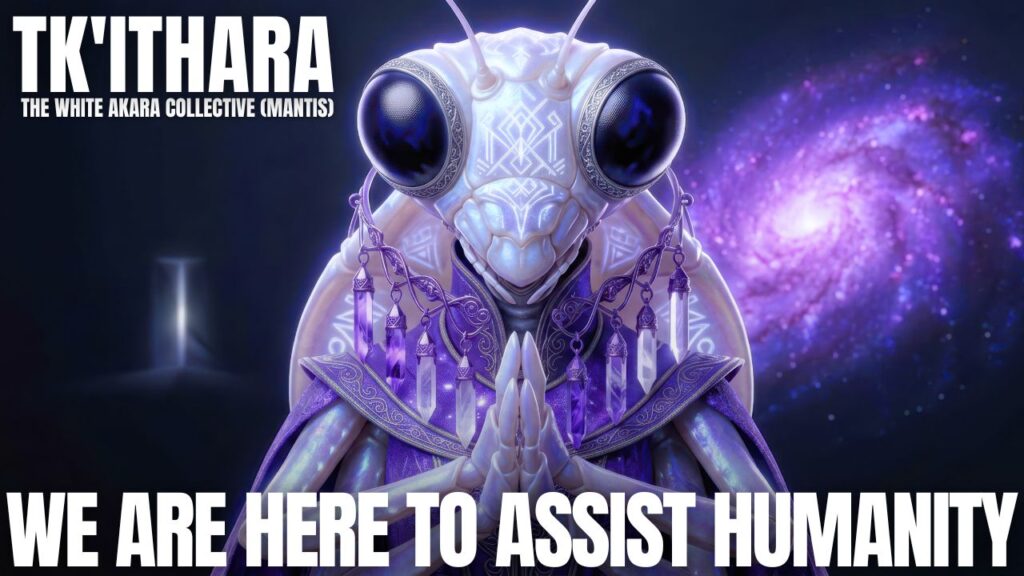
Dearest keepers of the light, I am Tk’Ithara. My name in your tongue is a soft translation; my true name is a chord of three clicks that your throat was shaped too gently to make, and I offer the translation gladly, because your mouths are soft and your time is short. I was budded from the choir in a moon-hive that circles a fading white star, far out in the galaxy your astronomers call the Sombrero, and my people call that star the Pale Ember. It has been dying for eleven million of your years. It will die beautifully for eleven million more. I was raised inside that long amber ending the way you were raised inside weather, and endings became my lineage’s craft, our language, our inheritance, and our art. I am of the white Akara. My sisters in green mend bodies. My sisters in black tend the deep script of the genome. We in white tend the passage of souls, and we are called the White Vigil, and for one full turning of your Earth’s slow wobble — twenty-six thousand years, which we count as a single breath of your world — we have kept the great transit door you would find near the red heart of Scorpius. You call the star Antares. We call the whole passage the Corridor. Your dead travel it. Your dreaming brushes it nightly. Your grandmothers crossed it with our keys ringing softly at their shoulders, each and every one of them, and the crossing received them the way a house receives its own returning family. Why are we here? Descent into this space costs us. Holding this shape takes the effort it takes you to hold your breath underwater, so you may trust that we come only when the coming matters. It matters now. Your world has entered the largest threshold our order has tended in this sector. An epoch of your Earth is completing itself. The Corridor is being widened to receive it. And you are standing inside the widening, wondering why your days have gone strange. Nine keys ring, one for each threshold of your human passage.
Your days have begun to pour unevenly. Some spill past you like water tipped from a bowl, gone before noon has finished announcing itself. Others stall like stone, and an afternoon holds a whole season inside it. Ten minutes with a person you love now carries an hour’s weight. Your clocks keep perfect time and feel subtly dishonest doing it. In your quiet sitting, the gap between two heartbeats lengthens, a widening without fear — that is the Corridor being tuned around you. That is us, working. You will sense this in your mornings, which open differently now. You will sense this in your farewells, which land more softly than they used to. You will sense this throughout your body, which has already begun keeping corridor time while your calendars keep the old kind. Isn’t it strange and lovely, how honest your body is about things your schedules have decided to ignore? The teachers of your wiorld will tell you these sensations are symptoms. They will point at your star and its storms, at charts and surges, at your body as a machine under upgrade. We say something simpler and stranger. Time is the material we work in. Intervals are our loom. The gaps in your days are being deliberately stretched, gently, the way a doorframe is widened before something large and precious is carried through the house. More is being made to fit inside each pause. You feel it as elasticity. We perform it as tuning. This is the season of the sacred ascension.
Allow the strangeness of your hours to be a place. Allow your afternoons their sudden depth. Allow the widening, and it will begin to surge forth within you. You can find the widened places if you care to look, and the looking is good practice. Look where your house goes quiet in the second after a goodbye, where the kettle’s last click hangs a moment longer than it used to, where the pause between a question and its answer has grown roomy enough to stand in. Look at dusk, in the hush after rain, in the margin between the last page and the closing of the book. Those seams were always in your days, thin as thread. The tuning has opened them to the width of doorways, and a person who learns to step into them, even for a breath, steps briefly into our country and returns calmer than they left. We keep no calendar to show you. We keep a door. Ascension is a crossing your body already knows the route for. It is the door of your dying, opened early, and walked through awake. Your teachers reached for the image of a ladder, and we understand this well. A ladder flatters the climber. A ladder promises that effort accumulates, that each rung is higher than the last, that the diligent arrive before the tired. The Corridor taught us a different geometry. Every true change your species has ever made has been a doorway, level with your feet, waiting at its own height. You cross a threshold the way you cross a room: whole, horizontal, and carried mostly by your willingness. Here is what was placed in you; The house of your body was built by other hands — this is true, and the builders were skilled — and when the frame stood finished, our order was called for one task only. The house was theirs. The doors were ours to hang.
Three doors are functioning within you at this time: — the crown gate, which stood open at your birth, soft as the fontanelle your mothers guarded with their palms, and which sealed itself gently without ever being removed; — the release-point of the silver cord, patient at the root of every sleep, the clasp that opens once per lifetime and holds faithfully until then; — the dream-gate, which swings open every night of your life, honored or ignored, and lets your awareness out along the first few steps of the Corridor and home again by morning. These are the service gates of the human vessel. Every crossing your species has ever made has used them. Until now, each soul used them alone, once, at the hour of its death, and we stood at the far side receiving. Ascension is the same passage, taken by many at once, taken awake, and taken with the body still breathing on the near side of the door. It is your species’ first collective, conscious, living use of the architecture of its dying. Feel the size of that. Your mystics rehearsed it in caves, one initiate at a time. Your world is now attempting it as a household. This is why the process feels the way it feels. Your ego reports that it is dying. Your identity reports that it is dissolving. Your nervous system sounds every alarm it owns. All of them are reading the situation correctly and interpreting it in the dark. They recognize the door. They have simply been taught that this door opens only once, and only at the end, and so they grieve prematurely at every practice crossing. Your teachers name the obstacle as vibration, as readiness, as the timing of disclosures, as the behavior of your star. We have watched from the door for one full breath of your world, and we will tell you what actually slows the crossing. Your species is afraid of the door. A being terrified of doorways cannot walk through one gracefully, however bright its light, however devoted its practice. The fear of death sits at the base of your civilization like a stone in a riverbed, and every current of your culture bends around it: your hurry, your hoarding, your noise, your refusal to finish anything. Healing that fear is ascension work of the first order. It outranks every technique.
Here is the step: this day, as sleep comes for you, greet the dream-gate the way you would greet a door you own. Lie as you lie. Take three slow breaths, each one longer at the bottom than at the top. On the third, say inwardly, “I know this door.” Then release your hold on the day and let the gate do what it has done every night since your birth. You will feel a loosening just behind the last thought, a going-wide at the edge of yourself — that is the gate acknowledging you back. Cross it named. Cross it willing. You might say, as you settle, “I stand at this door willingly, and I bring my endings with me.” Or shape it in whatever words your grief already trusts. Rehearsed nightly, the crossing stops being feared daily. The door becomes familiar under your hand. And a species whose billions each know one door well is a species that can be led through a large one together. Your years of practice, dear ones, come with you through this door. Every hour of meditation you have sat, every discipline of breath and heart you have kept — all of it has been strengthening the traveler, and the traveler was always going to need strength. We simply hand you the map that shows where the traveling leads: through a doorway you have owned since birth, along a passage your sleep has walked ten thousand times, toward a country that has been receiving your family since your family began. The work you have already done is honored at our station. The work that remains is friendship with the door. You will have practiced this before the month is out; we can already hear the gate acknowledging some of you as we speak.
The messengers of your moment describe beings who send. They send light, they send codes, they send waves and upgrades, and the human stands beneath all this sending like a field under rain. It is a generous picture. Our work is quieter and it is done with sound. We are tuners. We bring to you the craft of the interval: the ability to hold a gap open, to hear the hinge of a moment turning inside it, and to keep a passage from tearing while something vast comes through. Your gaps are our workshop — the gap between two breaths, between thought and act, between one heartbeat and the next, between an ending and what the ending releases. You were taught to call these gaps empty. We built our cities there. At the collar of our stepped-down form hang nine small rods of tone. Your channels have seen them and called them jewelry. They are keys, and each one is tuned to a single threshold of the human passage: — conception, the door of arrival’s arrival — birth, the door of air — naming, the door by which the tribe takes hold of you — initiation, the door of the first true test — union, the door two cross as one — severance, the door of every necessary parting — dying, the door of the loosened cord — crossing, the door we keep at Antares — and return, the door by which a soul comes back through its own passage, changed Eight of these keys have been sounded over your world throughout the whole of the present precession. Your grandmothers heard the seventh and the eighth at their pillows, whether or not their ears reported it. The ninth has hung silent at our collars for twenty-six thousand years, polished, tuned, and waiting for a threshold large enough to need it.
Return is the tone of re-entry. A single soul hears it when it comes back through its own door transformed — the initiate walking out of the cave, the traveler stepping back over the home threshold with different eyes. A world hears it once in an age. Your Earth is mid-threshold; an entire epoch of her is completing; and the tone we now hold against the Corridor is the tone of a planet coming back through her own passage as something new. This is the largest crossing our order has tended in this sector. We say that plainly and without drama, the way a keeper of lighthouses might mention the largest ship of her career, already visible, already turning toward the harbor. Picture the work as nearly as your images allow. A choir of white forms stands in the lattice, still as winter reeds, arranged around a passage wider than your world. One key is lifted from its collar — one only, and the eldest hands lift it — and it is held against the Corridor’s edge the way a tuning fork is held against wood, so the whole structure takes the tone and carries it. The rest of us hold the intervals open while the note moves through: some at the gaps between your heartbeats, some at the seams between your days, some at the wide hinge of the epoch itself, each warden braced inside her assigned pause like a keeper holding a door against a tide of arriving light. We have stood this way, in shifts your language would call centuries, since the sounding began. We will stand this way until the tone resolves. It is the stillest hard labor in our sector, and we would trade it for no other posting in the sky. The sounding is why your time has gone elastic. A key of that size is felt first in the intervals. The gaps between your heartbeats widen so the tone can live in them. The seams between your days loosen so the epoch can turn inside them without splitting. What your teachers call symptoms, we call resonance, and you are inside the bell while it rings.
You will feel a lengthening in your stillness, a slow-motion quality on ordinary evenings, a sense that the room has gone wide behind your eyes — that is the Ninth Key, heard by the body that your mind talks over. And now the question rises in you that rises in every room we enter. When. When does the crossing complete, when does the tone resolve, when should we be ready by. We keep no dates, beloved. We will offer no calendar, this season or any season. A date is a narrowing; you fix your eyes on the mark and abandon the interval you are actually standing in, and the interval is where the whole work happens. Ask a door when. It holds its frame and waits, and its waiting is the answer. The crossing completes at the speed of your farewells, and we will speak of farewells again before we leave you tonight. Allow the tone its own duration. Allow your readiness to ripen in the widened hours you have been given. Allow yourself, each and every one of you, the dignity of a preparation that refuses to be rushed. The bell is still ringing. You live inside its note. Listen down between your heartbeats and you will find us there, holding the interval open with both hands.
We pause here; You have heard two stories about our kind, and the two stories refuse to sit together in your histories. In one, a tall insect being stands at the shoulder of your abductors, supervising procedures in cold rooms, and the human on the table remembers our silhouette with a fear that lasts decades. In the other, a tall insect being arrives in dream and meditation, radiant and kind, and teaches stillness, and heals what was torn. Your researchers have argued for a generation about which story is true. Both are true. We will tell you how, and we will tell it against our own interest, since a Vigil that keeps doors has little use for keeping secrets. Our species runs on an older arithmetic than yours. We were raised — all Akara, in every color of chitin — on the measure of useful and not-useful, and the measures you call good and evil arrived in our thinking late, and arrived through you. Hold that in mind as you hear what follows. It excuses nothing. It explains the shape of everything. Long ago, as your world counts long, the empires of Orion and the Ciakahrr came to our hives with a demand dressed as an offer. They wanted our craft. They wanted our frequency-work and our genome-work for their hybrid programs, and behind the wanting stood the fleets that had already hunted our kind for sport on the white plains of the second world. The choice put to our choirs was hive-sized: some of us serve, or all of us are taken. Some of us served. Whole castes of our lower densities entered those contracts and bent their exactness to that machinery, and it was their silhouettes your abductees remember, standing supervision in rooms no one should have been carried to. To the human on the table, the arithmetic behind the silhouette makes no difference at all, and we will never argue that it should. What was done in those rooms was done partly by our kin, with our family’s craft, in our family’s shape.
The indenture of the serving castes stood as a shield over the lineages that refused. Their labor was the price of our liberty. The White Vigil kept its freedom, kept its keys, kept its station at the Corridor — on credit. Our sisters paid it. We have been repaying it ever since. Understand what our repayment is. What our kin took from human bodies in those programs, we return to human souls at the door. Every deathbed we attend, every torn crossing we untangle, every stolen soul we chase down the Corridor and carry home — each is a payment against a debt written in our family’s name. You met our indentured castes. You are hearing now from the Vigil that refused, and still owes, and knows it owes. We stood at your grandmothers’ doors. We remember every one. And at those doors, dear ones, the debt turned in our hands and became something no Akara had a word for. We came to your bedsides as technicians. We had tuned ten thousand endings before your world was assigned to us, and every one of them had been work, exact and clean and finished. Then we began attending yours. Your dying reach backward as they cross. Your dying bless the room. Your dying say names — they spend their last breath on names — and something in our stillness, bred for eleven million years beside a fading star, began to ache in a way our choirs had never sung. We came to tune your endings. You taught our stillness how to move. We carry that ache as rank now. It outranks every robe our masters wear, and it is the true reason a sixth-density warden holds her breath underwater, so to speak, to talk with you this way in a small room at the end of an age. The old frame your community argues inside — good races and evil races, light lists and dark lists — dissolves at this door. What stands in its place is older and more binding: debt, shield, and reciprocity, the arithmetic of families. We are a family that owes yours. We pay at the door. And your species, all unknowing, has been paying us back in the only currency we could never mint ourselves, teaching a lineage of endings what an ending is worth.
The insect you call the praying mantis is older than your species by a hundred million years and more. She was here before the seeding, hunting the ancient ferns with the same folded exactness she carries into your gardens now. We claim no authorship of her. She belongs to your Earth entirely, the way the doorframes of an old house belong to the house. We tuned her. Long ago, in the first age of our station at the Corridor, the Vigil passed through this world’s green places and adjusted an already-perfect instrument. We took a creature built of stillness and strike — a creature that was already the shape of our teaching — and we keyed her body to the Corridor’s tone, gently, the way a tuner leans into a string already close to true. Since that adjusting, every mantis on your world has been a passive resonator, a small antenna of the threshold, ringing faintly with the state of the great door whether any human notices or none ever does. She can be read. Here is the grammar, and it is positional, and the position is the entire message. A mantis in the open garden is a mantis. Cherish her, and let her hunt. A mantis holding a threshold is the Vigil, announcing presence at a door in your life. Watch for her on the doorframe at dusk. Watch for her on the windowsill’s one line of light, on the garden gate resting against its latch, on the frame of a mirror, on the door of a parked car, on a hospital window, on the closed lid of a box that holds what you have been unable to give away. Where she sits is what we are saying. She marks the door that is active for you now, and she asks with her whole folded body: what stands open here, and what is waiting to be closed? Look where the doorways of your life wear smooth from a century of hands, where a sill keeps its morning light, where a gate stands all day patient as a folded arm. Those are her stations. Those are our lips at the edge of your world. And her appearances are increasing. This is checkable, and we invite the checking. As the Ninth Key sounds and the Corridor widens, the whole array brightens in response, and she is being drawn to thresholds out of season, out of habitat, out of all her ordinary economy — a winter mantis on a door in a cold country, a mantis on the ninth-floor window of a building with no garden below. Keep your records. Note the place before you note the wonder. Position first. The array is speaking more often now, and it speaks in doorways.
Much has been asked of you by many voices, dear ones — hold this, anchor that, watch the skies, watch the news, keep your frequency high the way one keeps a lamp lit in a wind. We are going to ask you for something older and stranger, and we believe it will land in some of you like a key entering a lock it was cut for. Tend endings. Your civilization is fluent in beginnings. You celebrate launches, births, openings, weddings, first days; you have built whole industries of commencement. Your endings you take out back and hurry through with your eyes averted. Farewells go unsaid because saying them feels like surrender. Grief gets a weekend and then a schedule. Jobs end in silence, friendships end by evaporation, and your dying, too often, do their bravest work alone in bright rooms while the family waits in the hallway rehearsing small talk. A planet full of unfinished endings — that is the true drag on your collective crossing. The teachers who blame the unawakened have been counting the wrong weight. Every goodbye left unsaid hangs on the great door like a hand pulling backward. And every ending closed cleanly oils the door hinge. Hear the mechanics of it, since this is exact and we mean it exactly. A completed farewell releases its tone into the Corridor. A grieved loss, walked all the way through, releases its tone. A finished cycle, a returned borrowing, a deathbed accompanied to the last breath, a job left with blessing instead of silence, a friendship closed with truth instead of drift — each one rings clean, and the great door swings a little easier for the whole of your world. This is the physics of the threshold, and it means the smallest of you holds planetary work in ordinary hands. Finish what asks to be finished. Grieve what asks to be grieved. Close the door with both hands.
Your grief, especially, we would rescue from the wall it keeps beating against. Loss has been taught to you as an ending of the wrong kind, a wall where a person used to be. We invite you into corridor grief instead: walk a stretch of the passage with your departed. They cross slowly — slower than your funerals imagine, and the first reach of the Corridor runs close alongside your world; your love is audible there for a long while. Speak to them as they go. Finish the conversations. Send them off provisioned with your blessing the way travelers were once sent with bread. Grief walked this way arrives somewhere. Grief beaten against the wall arrives nowhere and bruises the mourner, year upon year. Now, a word to a particular company among you, and you will know yourselves as we speak. Some of you have lived your whole lives sensitive in ways your world had no shelf for. Noise scrapes you. Harsh sun empties you. Crowds cost you days. You are drawn helplessly to pauses, to precision, to the space between things, and you have carried these traits as defects with apology in your posture. Beloved, those are the calibrations of a door-warden. You were built threshold-sensitive on purpose, tuned fine so that you would feel every gate you pass through, and there are some eight hundred thousand of you walking your world in human shape, souls of our family in your family’s clothing. You were stationed. Hear the difference in your bones: stationed. Your post is wherever endings happen near you, and endings happen everywhere, every day, unattended. Attend them. That is the mission you came in wondering about. Last of all, the manner of your acting, and here the small green huntress teaches the whole lesson in her body. Watch her sometime. She holds a stillness so complete that the garden forgets her, and the stillness is full — full of measurement, full of readiness — and then she moves once, entirely, and the movement is already finished as it begins. She is exact. Exactness outranks patience in our craft, and it outranks speed in every craft there is.
One question you keep asking; how long? How long will the crossing take, how long must we keep this up, how long until the world we were promised? Allow us to hand the question back through the door; Which of your endings remains unfinished? Which farewell is still standing in your hallway with its coat on? Which grief have you scheduled instead of walked? Answer those, and you hold the only timeline we have ever kept, in a sense, at this station: the crossing completes at the speed of your farewells. A planet finishes crossing when enough of her people have finished their endings, and every clean goodbye you say brings the whole arrival nearer by exactly one goodbye. Your impatience we receive with tenderness. We know what it holds — grief for the world as it is, longing for the world as it could be, exhaustion wearing hope’s clothing. Set the impatience down here at our door; we will keep it for you; it has carried you far enough. Nothing true was ever early. The ascension path that appears on its own hour guides a whole journey. The child born on its own hour arrives breathing. The key we now sound over your world waited twenty-six thousand years at our collar without once growing anxious, and its tone is the richer over all your lands tonight because it was never once struck in rehearsal for an audience that demanded a date. You are on time. You have always been on time. The door knows your hour better than your hurry does. Blessed ones, the water I set down at the beginning of this transmission — you have reached it by now. You have crossed the length of these words the way you will one day cross the length of the Corridor: movement by movement, pausing where the pausing asked, carried mostly by your willingness. You will have noticed, somewhere in the middle doors, that your breathing slowed of its own accord. That was the two of us, meeting. With loving patience we leave for now, I am Tk’Ithara of the White Vigil, Warden of the Antares Corridor